 |
|
|||||||||||||||
 |
|






|
|
|
||||||||||||||||||||||||||||||
Why
use Linux for Computer Telephony Development? Linux is a perfect operating system for Computer Telephony because:
For these reasons many enterprise-scale telephony systems and large PBXs run some form of unix based operating system like Linux. Why Open Source in Computer Telephony?It is only natural to extend the benefits of open source to computer telephony, especially when the computer is running an open source operating system such as Linux and telephony while being a crucial business and social enabler, is typically closed and still under the control of the supplier. Combining open source application software running on Linux based commodity PC servers gives you total control at a very low cost base. Open Source effectively increases user adoption by:
Open source eliminates the barriers to knowledge, thus increasing competition amongst vendors and service providers, promoting innovation and eliminating the opportunity for monopolization. For developers, it enables them to avoid the duplication of effort, allowing them to concentrate on adding value by building on the foundation of others. Please note: It does expect you to provide some sweat equity and a level of competence. Like most things: The MORE you put in the GREATER the reward. Production
Cost
By using Open Source software, telephony systems can be built for the price of a
telephony card, a PC and a little effort. This can give your company a
tremendous cost advantage over traditional business models,
that charge largely for their proprietary software. End-users can use this cost advantage to build and maintain their own low cost, high
quality telephony systems. VARs can use this cost advantage to lower their production costs, enabling higher profits or generating a competitive
advantage through lower pricing to the customer. Maintenance
Costs
Why should Linux
Developers choose Voicetronix? Voicetronix is one of the few computer telephony hardware vendors that not only provides open source hardware
drivers that run on Linux but also offers solutions. It develops and makes available freely its own open source application software that is fully compatible and optimised for its hardware products. Developers wishing to use our hardware and software building blocks as their solutions are not shunted off to a forum but get to communicate with the actual engineers that have developed these product offerings.
Developers wishing to contribute don't have to sign over or waiver their copyrights for a nominal amount unlike some other vendors who wish to commercialise your contributions. Our software is LGPL and can be used with other open source or proprietary software. Note: Please read carefully the conditions of each license especially when using other open source libraries as it could be incompatible with proprietary software. Whether you are purchasing our telephony hardware, running our application software or engaging our professional services, rest assured that you are partnering with an organisation that has been pioneering open source telephony since 1999.
Voicetronix Open Source Application Software and Development Tools
Voicetronix over the years has developed a number of open source telephony applications and development tools that fully support our range of telephony hardware. Our latest offerings include:
In the past we developed and supported the following:
In addition, there are several other projects that are currently under development and are scheduled to be released in the near future. These include:
These will be ably supported by some new telephony hardware that has been specifically designed for converged traditional fixed line and VOIP centric environments. Other third party Open Source Projects Voicetronix has participated in the following third party open source projects in the past:
VPB Driver The majority of the original VPB driver implementation was designed way back in 1997 to provide similar functionality to the previous defacto standard of telephony APIs of that time, the Dialogic API. Originally written for Windows NT, it has been ported to Linux, Windows 2000 & XP. There was a FreeBSD version of the driver (thanks largerly to the work of Chris Forkin). The driver has been running under Linux and Windows for over 16 years and is both solid and stable. It is licensed under the LGPL license to enable it to be freely included in both open and closed source products. A comprehensive open source library, it provided developers with total control over our telephony hardware for any application, and a large variety of successful projects were built on its foundations. Further development on this driver has ceased and current work on it is limited to maintenance for OS changes and bug fixes, the latter of which is far more seldom than the former these days. We recommend that customers use libctpp, our next generation telephony driver and API for any new telephony projects. A client/server library for rapid Computer Telephony application development in Perl. It uses Voicetronix hardware, and runs under Linux.
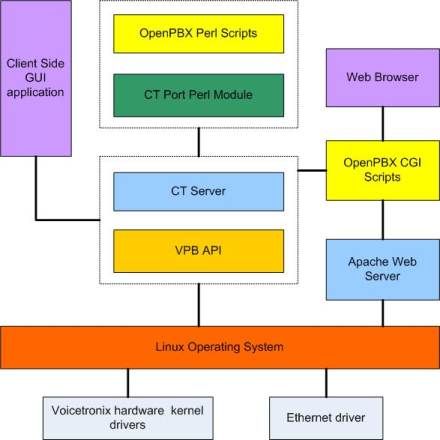
A block diagram illustrating the main building blocks of our OpenPBX software application that has been written using CT server is presented below.
CT Server Programming Model The programming model is based on the ccscript language developed by David Sugar for the IVR server Bayonne. David developed his scripting language to enable elegant implementations of IVR menus. Typically Bayonne applications use ccscript for menus, then shell out to Perl or other programming languages for other tasks such as database lookup and complicated logic. CT server uses a variation of this approach. Rather than writing a new language, the advantages of the ccscript programming model have been imported into a powerful existing language (Perl) by writing a small library. This allows computer telephony applications to be written entirely in one language. The result is an easy way to write application software. Perl is a very useful language for telephony, as demonstrated by our OpenPBX application that only needed 1000 lines of code to provide the basic PBX functionality. It is possible to write CT applications in a fraction of the time it takes in C/C++. There is a single Perl process for each phone line. To support multiple lines, start multiple Perl processes, one for each line.
|
||||||||||||||||||||||||||||||||
© Copyright 1995-2017 VoiceTronix Pty Ltd |
||||||||||||||||||||||||||||||||